HostPilot Guest / THE CONNECTED VILLA BUSINESS
A remarkable stay.
At their fingertips.
Arrival details, house essentials and memorable extras, in a link guests can open on their phone. Help them find answers, request services and enjoy more of the stay — while your team keeps the operation connected.
See what’s included
- Arrival countdown, plus the door code and Wi-Fi your team set, shown on the morning of check-in
- Guest check-in progress and staff-recorded local reporting status
- House manual, directions and villa rules in one place
- Paid add-on catalogue with a running total
- Every add-on a guest requests appears in the ops task board straight away
- No app store download — it opens from a link
- Tours, activities and transfers, curated per villa by your own team
- Transfer prices set per villa, per destination — not one island-wide rate
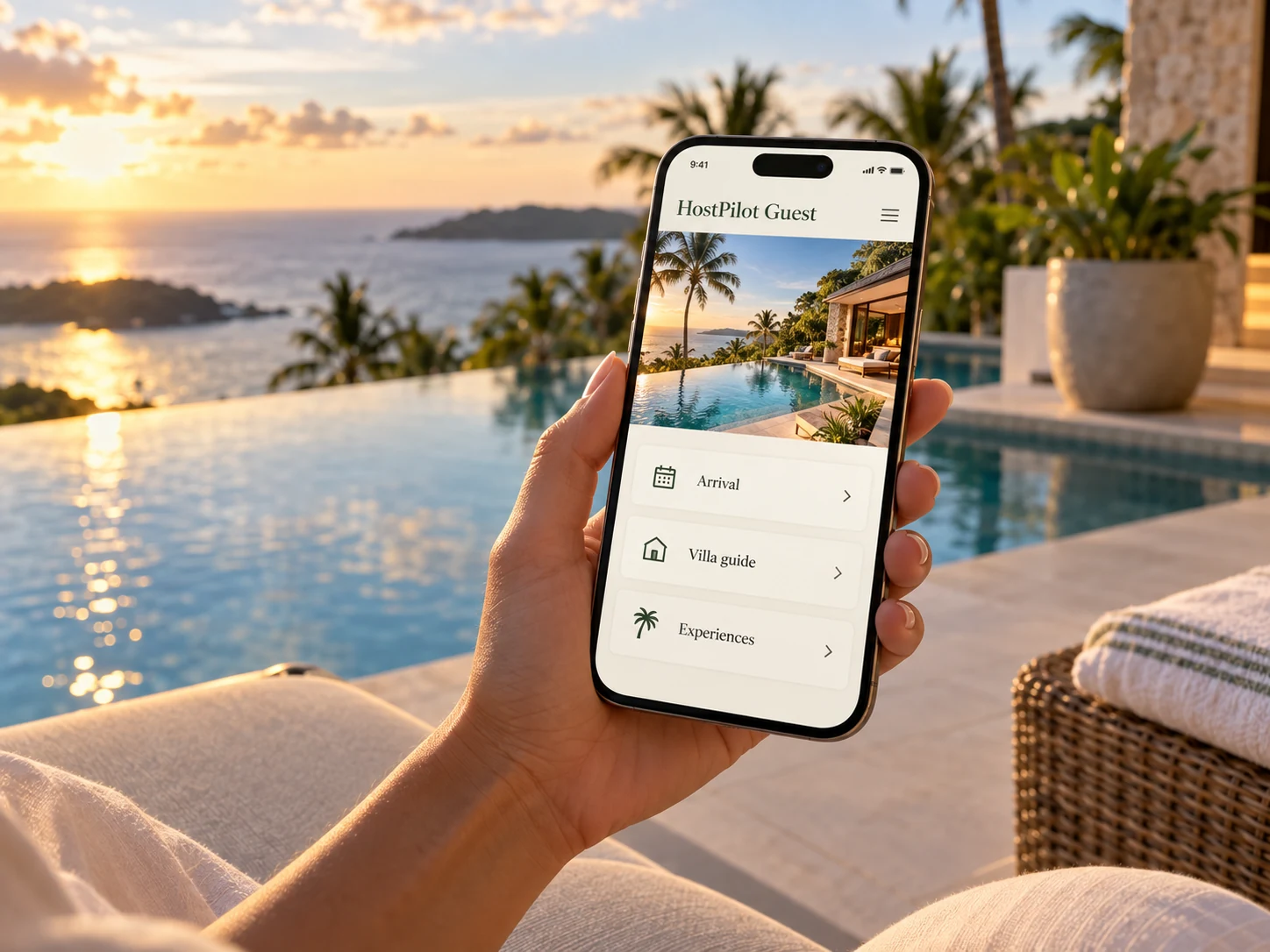
Your villa team reviews and confirms the request.
Lifestyle scene and screen are illustrative. Guest service requests need team confirmation; payment methods are enabled and verified during operator setup.

Villa Sunset Sapphire
Add to your stay
Add-on revenue booked on this single seven-night stay. Guests buy more when the list is in their pocket instead of in an email. That is the argument for the guest app paying for itself.
A useful guest portal before, during and after arrival.
Help guests find answers, request services and understand what has been confirmed.
Collect guest details and passport documents, show check-in progress and provide the house manual, directions and configured access instructions.
Guests can follow service and transfer requests, ask for changes or cancellation and contact the team. Supplier confirmation remains a separate step.
Configured Stripe checkout supports card payments. Wise transfer instructions and Thailand’s PromptPay slip workflow provide additional options where enabled. Payment status follows reconciliation or staff verification, not a checkout return or an uploaded slip alone.
Request extra nights and changes to scheduled property visits. The office checks availability and confirms the request.
A mid-stay check-in lets guests raise a concern while the team can still respond. Contextual concierge assistance also offers a route to a human.
Bring villa guidance, weather, experiences and relevant local notices into the guest’s stay context.
฿24,950 on one seven-night stay.
That figure is from the demo portfolio, not a customer average — we will not publish an uplift percentage we cannot show you on screen. Guests can browse prices and request services from their stay portal.
Transfer ฿1,400 · chef ฿4,800 an evening · charter ฿18,500 · massage ฿1,200 an hour.
The guest requests it; the office sees a task and a charge to confirm, not a message to interpret.
Confirmed items are settled through your existing payment flow at checkout rather than chased in cash.
The catalogue, the suppliers and the markup are set by you, per villa.
The two hours that set the tone.
Most bad reviews are written about the first evening — a code that did not work, a gate nobody explained, an aircon remote in Thai.
The code your team set is shown when the stay starts and hidden when it ends. The lock itself is not connected to this system — your team sets the code.
Guests can see check-in progress and staff-recorded reporting status. In Thailand, TM30 spreadsheet preparation supports the team’s filing workflow.
Pinned location, gate instructions and the manager’s name and number.
Messages route to whoever is on duty, inside the same system as the tasks.
Tours, activities and transfers — curated per villa.
The experiences a guest sees are not a generic island list. Your team maintains the catalogue in the ops console and decides, villa by villa, what appears.
A per-villa visibility matrix controls which experiences each guest sees, with overrides for individual properties.
Set transfer prices for each villa and destination, reflecting the route and service your team offers.
Named editors maintain the experiences, their photography and their pricing. There are orders, sales and insight views behind it, and a commission-rules engine.
A guest requests; your office confirms with the supplier and settles the charge. There is no instant supplier confirmation and no automatic payment confirmation — the last step is a human, on purpose.
What’s next.
Explore the next capabilities in the ecosystem. These are separate from the working product; we will confirm scope and availability before including them in your rollout.
- Not startedConnected smart devices, starting with door locks
Today the smart-tech surface is a catalogue and an install request. Bringing the installed hardware itself into the portal — lock codes issued against a reservation, meter readings on the statement — has not started. Not a single device is connected yet, and the site will say so until one is.
What this does not do.
Every platform in this category oversells. Here is where the line is, so you do not find out on week three.
- It is not a booking engine — guests arrive with a reservation already made.
- Configured Stripe checkout supports card payments; Wise instructions and PromptPay evidence are available where enabled. Payment confirmation follows reconciliation or staff verification.
- It is a web app, not a native app. That is deliberate: nobody downloads software for one week.
- Add-on and transfer requests are not instantly confirmed with the supplier. Your team closes the loop.
- Door codes are issued and communicated by your team. No smart lock is connected to this system today.